




(original post-date: April 13, 2011)
I was late to the Netflix party.
One explanation, I suppose, is that I don’t feel compelled to rent movies that often. Also, I guess I wanted to support those stores that exist in real space and time and actually employ people who live in my ‘hood.
Less than a year ago, though, I decided to sign on and start designing my own queue, and maybe it was an incident a few months before that that helped incite the change… A friend and then-neighbor had raved about The Hangover. She’d seen it three times, in fact, and she told me she “pissed her pants” laughing. So, one afternoon, when a good pants-pissing comedy seemed in order, I rented the film.
And I watched it.
And I barely cracked a smile.
(Not my genre, I guess.)
The next day, I had to return it. And even though it was raining (which, in L.A., is often the top news story), I braved the inclement weather to return the stupid movie to the rental place. I also braved the rental place’s horrible parking lot, which was cleverly designed to facilitate fender benders.
By the time I got home (safely), I resented my otherwise dear neighbor-friend who had made the recommendation. It even occurred to my facetious mind that I should have asked her to return the stupid movie.
… When I received my first Netflix disc (which would have been a movie, though I don’t remember which one), my innate sense of rebellion came to the fore. I looked at the red envelope, and I thought, “I don’t have to watch this. You can’t make me watch this.”
Bizarre, I’ll admit.
After all, I was the one who had ordered it, for God’s sake.
But I hate being told what to do (even by me).
Or maybe I just hate being told when to do.
… After a few months on Netflix, and on the recommendation of a friend, I ordered Season One, Disc One of Six Feet Under. I found the first few episodes intriguing (if for no other reason than the eye candy of Peter Krause).
I also had lined up the series' subsequent discs on my queue, though they were separated by various other titles.
… Within a few weeks, when I was well into the second season of Six Feet Under, I realized that I could no longer take the interruptions from competing stories. I grabbed my mouse and made the big leap: Top of the Queue. Yup, the whole series. One disc after the other until the very end.
And having just completed the series the other night, I am here to say that Netflix rocks.
I cannot imagine having spent five years watching Six Feet Under. No more than I could imagine spending five years reading a great novel.
And Six Feet Under has all the trappings of a great novel: well-developed characters with distinct voices; interwoven plotlines that reveal the strengths and weaknesses of each of those characters; a balance of suspense, drama, and humor; and the interplay of day-to-day living with other-worldly occurrences.
Combine that with the trappings of a wonderful movie – talented actors; flawless direction; strong atmospheric details – and the ride goes to a new level of involvement.
A brilliant television series watched in as few sittings as possible is like a book-on-tape with moving pictures.
… When I lived in New York, a roommate once said to me, “I always know when you’re about to finish reading a novel, because you close your door.”
True. Because: if it’s the kind of novel I love, I usually cry at the end. (In fact, if I come to the end of a novel and I don’t cry, I feel a little short-changed.)
The other night, watching the final episode of Six Feet Under gave me all the emotional joy of a novel’s end. There remained conflict in the first half or so of the two-hour episode, but it worked its way beautifully to closure and resolution.
I had to hit the Pause button several times to wipe the salt stains off my glasses. And the next day, when I remembered specific scenes in the series finale, my eyes got wet again. The Fisher family had been a part of my life for several engaging weeks.
It’s funny, too; generally when I’ve finished watching a disc, I return it immediately to its red envelope and place it in the outgoing mail. But, I let that last episode sit on the sideboard for a few days. I didn’t want to part with it. I didn’t want to face the fact that the journey had come to an end.
I have a feeling I’ll be making my way over to Amazon one of these days, and I’ll purchase the full series. I can envision it up there on the bookshelf, between and among some of those novels that I know I’ll read again.
Showing posts with label characters. Show all posts
Showing posts with label characters. Show all posts
Monday, June 17, 2013


Wednesday, August 17, 2011
The End Will Present Itself (Just Let the Art Happen)
About a month ago, I pulled out my huge collection of beads and got drawn into the meditative process of jewelry-making. The foray was inspired by some unexpected sales. Thanks to a volunteer spokesmodel who travels in the right circles, two of my long necklaces got sold.
Correct that. One got sold; another got commissioned. So, in order to meet the commission request, I had to pull out the beads.
Once that happened, I was hooked again. Within two weeks, I’d made about six new long necklaces.
This line of long necklaces is one I started in the summer of ’07, and they are bold in design. Semi-precious stones are the focal point, and they come in large slabs, chunks, and nuggets.
Some are polished. Some are raw. Some are faceted.
I generally throw in a metal as well, and I accent all these primary components with small crystals and an assortment of vintage glass beads.
Although it had been more than a year since I had composed one of these sassy, self-assured four-foot numbers, I quickly returned to the relaxing routine, and as I was into the third or fourth necklace, I had a fascinating revelation: the process I intuitively follow when making a long necklace is exactly the same as the process I have followed when writing a novel.
...When I begin making a long necklace, I have no vision of the ultimate design. I have only a palette of beads, sitting in one of two small plates within reach.
With one half of the toggle clasp crimped onto the end of an adequately long piece of beading wire, I begin stringing the beads.
I don’t give it a lot of thought; I just relax and let the art happen.
At every one- to three-inch interval, I study what I have composed, and if there is something not quite right in the order of a few beads, I know it immediately. I remove the bead sequence that seems misdirected, and I restring, thus fixing the problem.
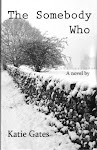
...When I wrote my first novel, The Somebody Who, I had one idea: a woman whose husband has Alzheimer’s would begin dating. I didn’t know how that dating would happen or what would result from it, but I liked the concept.
Before I got fully into the writing, I selected my characters. The biggest “bead” was Evelyn, and her family -- a husband, four children, and two of their spouses -- were primary among the other nuggets, slabs, and chunks.
(Some polished. Some raw. Some faceted.)
A few individuals outside the family also were in the mix, and with the palette thus established, I’d write a chapter or two, letting the dialogue and therefore the plotline go where it might.
The day after each night’s writing session, I’d review what I had written the previous evening, and where “beads” needed to be removed or rearranged, I made the edits.
...In my long necklaces, this intuitive approach continues for the first twenty-four inches or so. As many as twenty times, I hold up my work-in-progress and look at the latest “chapter.” When necessary, I readjust the order of things.
Once I’ve passed the halfway mark, however, the process changes. At that point, I deliberately hold up the necklace and study it. I bring the exposed wire up to the crimped toggle. I consider the necklace’s eventual end with its now-established beginning.
Which is to say, on the right is a beaded half-a-necklace; on the left is a naked string.
This is when I begin planning. This is when I consciously decide what beads I want to use next. I choose the order of placements as I work my way up to the final bead.
...By about the halfway point of The Somebody Who, all the characters had emerged fully, and because they had, they also needed to go in particular directions. I would find myself in the middle of writing one chapter when the idea for a subsequent chapter would pop into my head. I’d quickly jot it down and return to the page at hand. The further I got into the second half, the more ideas I had for the final chapters.
Similarly, with my second (not yet published) novel, Martin Lost and Found, weird things happened once I made that homestretch turn.
I had begun that novel with only the germ of an idea. On a sheet of paper, I wrote: “Regaining hope. The shit hits the fan. See what happens.”
Martin – my distinctly primary bead (raw, but also faceted) – had a face and a voice at the novel's start. I also gave him a context when I placed him in an apartment building in my neighborhood.
Slowly, the other characters (co-workers and neighbors) emerged, and as they spoke and interacted with him, their value to the story became apparent.
After what would become the halfway mark, I was once again jotting down ideas for future chapters.
At one point, I made a note that the novel’s final scene should take place at a certain restaurant.
And when I reached the end, and one of the smaller primary beads (polished, despite his youth) insisted that I look up the meaning of that restaurant’s name, that name turned out to be perfect.
In meaning, the restaurant's name was pretty much the same as “regaining hope.”
...I love the ride.
I love the ride when I just let the art happen.
Subscribe to:
Posts (Atom)